
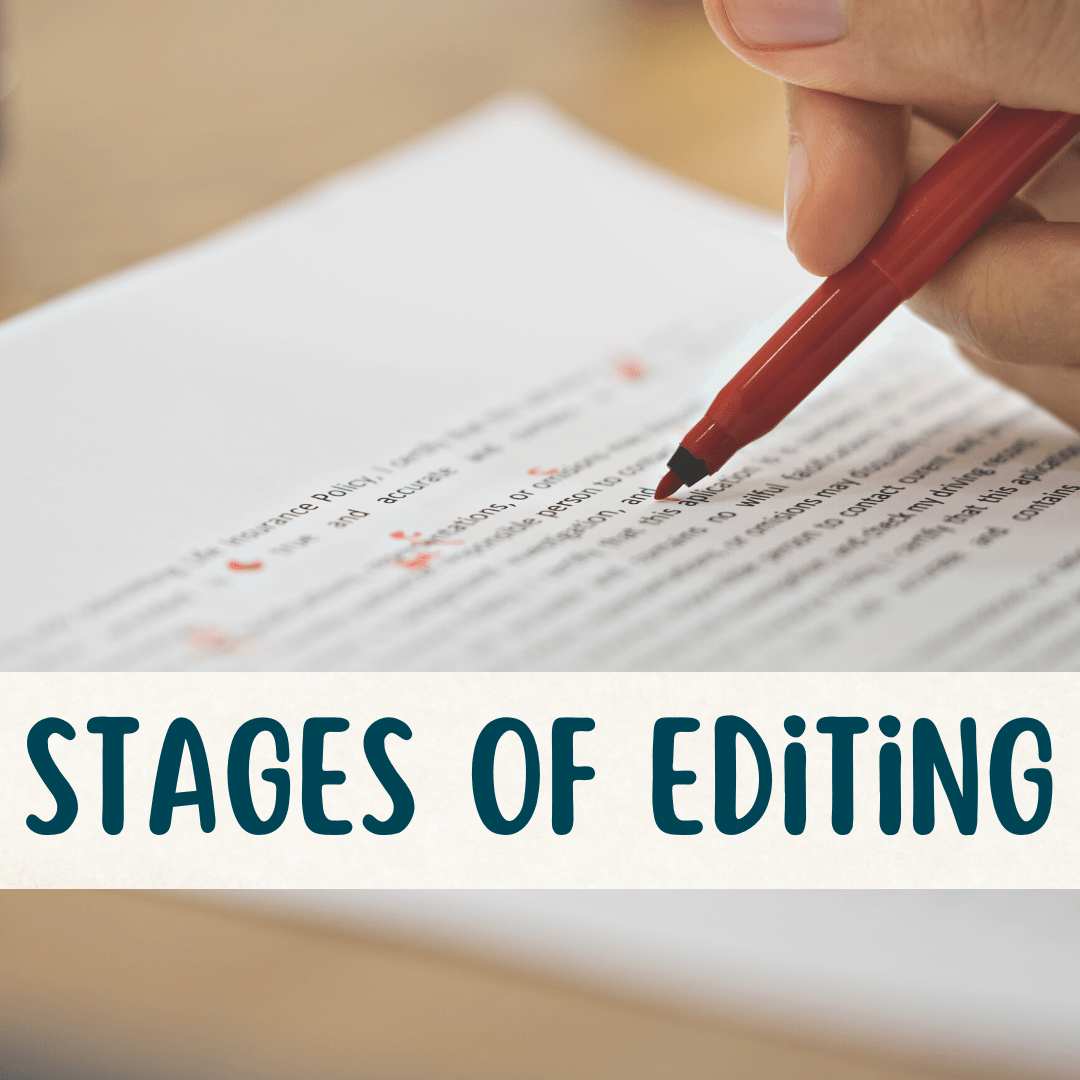
For aspiring writers and seasoned members of the writing community, the editing process is often met with a myriad of reactions. In some cases, writers are eager to begin—after all, reaching the editing milestone means a first draft has been written, and writer’s block has been conquered, at least to some extent. For others, editing can seem like an overwhelming endeavor. Nonetheless, editing is a crucial step for every writer.
A broad term used to refer to the multi-stage method of revising your content, editing is the second step of the writing process, during which you begin to revise, re-work, and enhance what you’ve already written. Simply put, once you’ve completed your first draft, it’s time to start editing. If you’re wondering about the nuances of the umbrella term “editing,” though, you aren’t alone; many writers find themselves asking what the editing process entails, which type of editing should come first, and why certain steps should follow others. Below, we’ve provided a brief breakdown of the stages of editing.
A Preliminary Read-Through
We advise writers to take a break from their manuscript before making any revisions. Although it might seem counterintuitive—especially if you’re working toward a deadline—taking some time away from your manuscript can improve your ability to edit the content. As you write, it’s easy to become immersed in your story or the message you’re aiming to convey; in fact, it’s common to become so enmeshed in the content that it can be difficult to take a step back and objectively review it. Ultimately, your first draft is the manifestation of your ideas, and no one knows the content as well as you…which is exactly what you need to remember once you begin editing.
Your first draft is the foundation upon which you’ll build and improve what will eventually become your final draft. And between your first and final drafts, it’s vital to keep the reader in mind; one of the goals of editing is to ensure the reader can envision and understand your story or message as vividly as you conceptualized it. But if you’ve spent weeks, months, or even years working on the content, it can be difficult (some would even say impossible) to finish your first draft then turn around and immediately begin editing it, which is why we recommend taking a break from it.
When you do return to your draft, we suggest you begin the editing stage by reading your manuscript from start to finish. After some time away from it, you’ll ideally be able to read your draft with fresh eyes, and we recommend taking notes and making minor copy edits along the way. Your notes may include ideas for content you wish to include in the next draft, changes you want to make, thoughts to fill in plot holes, and more as you assess if your story “works” (i.e., makes sense and is complete). You can use your notes while making developmental edits, and by making minor copy edits, you’ll ensure that your next draft will be a bit grammatically tidy, too.
Using your notes from your read-through, you can begin the first round of editing your manuscript: developmental editing.
The primary form of self-editing, developmental editing is the process of reading through your manuscript—usually multiple times—to evaluate if there’s a balance between the action/events and your character’s evolution, and if you can identify a clear beginning, middle, and end point of their journey.
This is the stage in which your word count will increase. As you edit, your word count will naturally rise as you add detail and nuance to your world-building and characters, as well as clarify events from the way you’ve imagined them to the way they’re interpreted by the reader.
You may want to contact an alpha reader for some outside feedback on your manuscript, but remember, an alpha reader is not the same thing as an editor. Once your developmental edits are complete, your manuscript has entered its beta version.
Next follows the line and copy editing process, which may be completed simultaneously.
Line editing focuses on writing style and voice at the sentence and paragraph level. It also assesses creative content from an overall perspective (i.e., a verification that the developmental editing process is otherwise complete). This includes perspective in storytelling and the balance of showing versus telling.
Copy editing focuses on grammar and addressing flaws on a technical level. This includes homophone usage and a consistency check on punctuation (capitalization, hyphenation, and numerals).
If you work with a professional copy editor, they should use a style guide, which will provide an accredited standard for their editorial style—and that style guide should match your genre (i.e., fiction vs. academic writing vs. memoir, etc.). Additionally, a copy editor will flag any unclear or inaccurate statements (ex., fact-checking statements in nonfiction or historical fiction) and keep a running tally of any issues with internal consistency (ex., if a character is described as wearing glasses but is later said to have never worn glasses).
If you’re wondering why line/copy editing follows developmental editing, that’s because most major manuscript adjustments are made during the developmental stage, when entire portions of a manuscript may be added or removed. For the sake of efficiency, it doesn’t make sense to perform a close edit of content that may ultimately be removed from the manuscript.
The final stage of editing, proofreading should only be done on an otherwise-finished version of your manuscript. This is the time to catch every typo, stylistic discrepancy, or any other error. Our minds can automatically fix errors and fill in gaps when we’re reading in our heads, especially when we’re really familiar with the content (like you will be by the time you reach the final stage of editing). So, we advise taking a break from your manuscript before embarking on the proofreading stage. Doing this will allow you to return with a fresh perspective. While perfection is an ideal few ever achieve, it is worth striving to reach a status close to it.
The editing process generates a revised version every time you work your way through it. For example, after working through your manuscript for the purposes of a developmental edit, you will have a revised version. Due to the importance of self-editing your completed draft, challenges can arise as you strive to provide adequate attention to each stage. We always advise that you work with a professional editor as well as alpha or beta readers and critique partners throughout the editing stage, although the exact type of editor(s) will vary in accordance with the unique needs of your manuscript. Finding the right editor for your manuscript will depend on which stage of editing you’re in, as well as the genre.
Of course, if you choose to query in the hopes of receiving a contractual offer from a literary agent or acquisitions editor, note that these stages should still be completed prior to querying so that you present the most polished version of your manuscript to those industry professionals.
As overwhelming as the entire editing process may seem at first glance, a thorough understanding of the process can help it seem a bit easier to start on. If you still have questions, be sure to check out our Editing Tips series for more information. And the writing community is full of industry professionals as well as experienced writers (and those just starting out!) who are generally eager to aid a fellow creative in understanding their next steps. We encourage you to look for writer support groups on Facebook, or to contact a professional on sites like Reedsy. No matter where you are in the process, though, remember to take it one step at a time.
 Josha Publishing, LLC